Showing posts with label machines. Show all posts

Sunday, 19 March 2017

Explain the Parallel Operation Of Two Synchronous Generators or Alternators???

Parallel Operation Of Two Synchronous Generators or Alternators :

The electricity demand of a country is fed by many alternators operating in parallel. There are various advantages of operating the alternators in parallel. some of them are listed below. 

  • For a given capacity of a generating station, either a single large unit or many small units may be installed. If there are many small units operating in parallel instead of the single large unit then a number of alternators operating at a time can be changed depending upon electricity requirements or load demands. This will in operating the alternator near its hill load capacity so that efficiency will also be better. Therefore operating cost will be significantly reduced compared to the single large unit.
*Principle and working of Synchronous generator or alternator : 
  • A particular unit may be shut down for certain period during the maintenance and inspection at the power stations. For that period the load can be transferred to other units if number of units are operating in parallel.
  • Several power stations are interconnected by a grid which is economical and advantageous. This will make sure the optimum utility of the alternators.
  • The continuity and reliability of the supply can be maintained at better level due to interconnections. 

There are certain requirements which must be met for parallel operation of alternators be reliable.
  • The rated speeds of the alternators should be such that they give same frequency generated voltage (f =PNs/120)
  • The output voltage rating of the alternators must be same. 
  • Even though the kVA ratings of the alternators are different, they should be of the same type so that waveform of generated voltage is same.
  • The armature of alternators should have reactance. 
  • The prime movers of the alternators should have same speed load drooping characteristics so that they can be loaded in proportion to their output ratings.

This conditions for proper synchronization of the alternators for the parallel operation to be successful are as given below. The alternator or group of alternators which are already in operation and sharing load are called running machines while the alternator which is to be connected to these alternators for parallel operation is called incoming machine. The incoming machine must meet the following conditions for proper parallel operation.

  • The terminal voltage of the incoming machine must be exactly same as that of the others or of the bus bars connecting them. 
  • The speed of the incoming machine must be such that its frequency if- PNs 120 equals the frequency of other machines or that of the bus bar. 
  • The phase of the incoming machine voltage must be same as that of the other machines or bus bar with respect to load. The phase voltages of incoming machine and bus bar should be in opposition which ensures that there is no circulating current between windings of alternators already in operation and the incoming machine. 

The interconnection of alternators i.e. the process of synchronization is already discussed previously. Now we will consider how the two alternators will operate parallel. What will happen if the driving torque or the excitation for any of the alternator is changed. In practice it is rare to have two alternators operating in parallel. But concept of parallel operation of alternators can be well understood by considering two alternators in parallel.

Consider two identical alternators connected in parallel as shown in below figure.


Here cylindrical rotor alternators are assumed for simplicity,but the results obtained are equally applicable to both salient and non-salient machines.


Solving above two equations,

If no load is connected to the alternators only circulating current Isy will flow in the circuit.The current is given by


Saturday, 4 February 2017

What is Three winding Transformer

Definition of Three-winding Transformer:

Sometimes in high rating transformer, the third winding is constructed in addition to the primary and the secondary windings. The third winding is called the tertiary winding, and because of the three windings, the transformer is called the three-winding transformer.

The voltage ratings of all the three windings of the transformer are usually unequal.The primary winding has the highest voltage rating; the tertiary has the lowest voltage rating, and the secondary has the intermediate voltage rating.

The chief advantages of the three winding transformer is an economy of construction and their great efficiency. The schematic diagram of a three-phase transformer is shown in the figure below.


For an ideal transformer,


The tertiary winding is connected in delta. The main advantage of the using tertiary winding is that the delta connection suppresses harmonic voltage generated in the primary and secondary windings of the transformer. The tertiary winding is also used for the following purposes.

  • Tertiary winding is used to supply substation auxiliaries (for example, lights, fans, and pumps) at a voltage different from those of the primary and secondary windings.
  • The synchronous capacitor or static high voltage capacitor is connected across the delta-connected output of the tertiary winding for reactive power injection into the system for either power factor connection or voltage regulation.
  • It is used to interconnect the three supply system operating at different voltages.
  • The delta connected tertiary reduces the impedances offered to the zero sequence currents to allow sufficient earth fault current for proper operation of protective devices.
  • Tertiary can be used for measuring the voltage of the high voltage testing transformer.
The unbalanced and third harmonic problem does not arise when one or both sets of windings are connected in delta. Usually, the rating of the three winding transformer is up to 35 percent of the total VA ratings of the transformer.

Equivalent Circuit of a Three Winding Transformer:

The equivalent circuit of a three winding transformer is shown in the figure below.Each winding is represented by its equivalent resistance and reactance. R1, R2, R3 are the resistances and the X1, X2, and X3 are the impedance of the primary, secondary and tertiary windings of the transformer.


If the excitation current is considered then, the R0 and X0 can be connected as shown in the figure above. The V1, V2, V3 are the voltages and the I1, I2, I3 are the currents of primary, secondary, and tertiary windings.


Determination of Parameters of Three-Windings Transformers:


The parameters of the equivalent circuit can be determined from the open circuit and the three short circuit tests.

Short Circuit Test:


The equivalent leakage impedances Z1, Z2 and Z3, referred to a common base can be determined by performing the three short circuits.  In the first test, the winding two is short-circuited, winding three is kept open circuited, and a low voltage is applied to winding one so that the fault loads current flows in windings 2

The voltage, current and power input to winding one are measured. Let the V1, I1 and P1 be the voltmeter, ammeter and wattmeter reading respectively.The Z12 indicates the short-circuit impedances of windings 1 and 2 with winding three open. Then ,


Equivalent resistance,

Equivalent leakage reactance,


The Z12 is the series combination of Z1 and Z2 respectively,


In the second short circuit test the winding three is a short-circuited and winding two is kept open. The low voltage is applied to winding 1 to circulate the full load current in winding 3. If Z13 represents the short circuit impedance of winding one and three with winding two left open.

                                                             Z23=Z2+Z3

In the third short circuit test, the winding three is short-circuited, and the winding one is kept open. The low voltage is applied to winding 2 to circulate the full load current in the short circuit winding 3. The Z23 represents the short circuit impedance to winding 2 and 3 with winding one open.


Solving equation (1), (2) and (3) we get the leakage impedance Z1, Z2 and Z3 all referred to as primary,


Open-Circuit Test:

The open circuit test is carried out to determine the core loss, magnetising impedance and turn ratios. In open circuit test the voltmeter, ammeter and wattmeter are connected in low voltage winding. The secondary side is kept open, and the voltmeter is connected.

Since the high voltage side is opened the current drawn by the primary is no load current and I0 measured by the ammeter A. The magnetising impedance may be found by exciting current winding 1 with both winding 2 and 3 be open circuit. Then we have,


The voltage regulation of a three-winding transformer is defined as the ratio of the magnitude of the actual kVA loading of the winding to the base kVA used in determining the network parameters.

Friday, 27 January 2017

waht is Step-up Transformer & Step-down Transformer

Step-up and Step-down Transformers:

Step-up Transformer:

A transformer in which the output (secondary) voltage is greater than its input (primary) voltage is called a step-up transformer. The step-up transformer decreases the output current for keeping the input and output power of the system equal.

Considered a step-up transformer shown in the figure below. The E1 and E2 are the voltages, and T1 and T2 are the number of turns on the primary winding and secondary winding of the transformer.


                      The number of turns on the secondary of the transformer is greater than that of the primary, i.e., T2 > T1.Thus the voltage turn ratio of the step-up transformer is 1:2. The primary winding of the step-up transformer is made up of thick insulated copper wire because the low magnitude current flows through it.

Applications of Step-up transformer: 

                      Step-up transformer is used in transmission lines for transforming the high voltage produced by the alternator.The power loss of the transmission line is directly proportional to the square of the current flows through it.


                                                                   Power = I2R

                      The output current of the step-up transformer is less, and hence it is used for reducing the power loss. The step-up transformer is also used for starting the electrical motor, in the microwave oven, X-rays machines, etc.

Step-down Transformer:

                       A transformer in which the output (secondary) voltage is less than its input (primary) voltage is called a step-down transformer. The number of turns on the primary of the transformer is greater than the turn on the secondary of the transformer, i.e., T2 < T1. The step-down transformer is shown in the figure below.


                        The voltage turn ratio of the step-down transformer is 2:1. The voltage turn ratio determines the magnitude of voltage transforms from primary to secondary windings of the transformer.

                        Step-down transformer is made up of two or more coil wound on the iron core of the transformer. It works on the principle of magnetic induction between the coils. The voltage applied to the primary of the coil magnetise the iron core which induces the secondary windings of the transformer. Thus the voltage transforms from primary to the secondary winding of the transformer.

Applications of Step-down transformer:

                       It is used for electrical isolation, in a power distribution network, for controlling the home appliances, in a doorbell, etc.

What is Transformer Winding Resistance

Transformer Winding Resistance:

The ideal transformer has no resistance, but in the actual transformer, there is always some resistance to the primary and secondary windings. These resistances are shown external to the windings in the figure below.


For making the calculation easy the resistance of the transformer can be transferred to the either side. The resistance is transferred from one side to another in such a manner that the percentage voltage drop remains the same when represented on the either side.

                          Let the primary resistance R1 be transferred to the secondary side, and the new value of this resistance be R’1. The R’1 is called the equivalent resistance of primary referred to secondary side as shown in the figure below. I1 and I2 are the full load primary and secondary current respectively.


Then,


Total equivalent resistance referred to secondary,


                            Now consider resistance R2, when it is transferred to primary, the value of the new resistance is R’2. The R’2 is called the equivalent resistance of the of secondary referred to as primary as shown in the figure below.


Then,


Total equivalent resistance referred to primary,


What is Construction of Three Phase Transformer

Construction of Three Phase Transformer:

A three phase transformer is used to transfer a large amount of power. The three phase transformer is required to step-up and step-down the voltages at various stages of a power system network. 

The three phase transformer is constructed in two ways.
  • Three separate single phase transformer is suitably connected for three phase operation.
  • A single three phase transformer in which the cores and windings for all the three phases are merged into a single structure.
The core of the three phase transformer is mainly classified into two types, i.e., 
                                                               1.The core type transformer 
                                                               2.The shell type transformer.

Core Type Three Phase Transformer:

                     Consider a three single phase core type transformer positioned at 120° to each other as shown in the figure below. If the balanced three-phase sinusoidal voltages are applied to the windings, the fluxes φa, φb and φc will also be sinusoidal and balanced. If the three legs carrying these fluxes are combined, the total flux in the merged leg becomes zero. This leg can, therefore, be removed because it carries the no flux. This structure is not convenient for the core.


                      The core of the three phase transformer is usually made up of three limbs in the same plane. This can be built using stack lamination. The each leg of this core carries the low voltage and high voltage winding. The low voltage windings are insulated from the core than the high voltage windings.


                      The low windings are placed next to the core with suitable insulation between the core and the low voltage windings. The high voltage windings are placed over the low voltage windings with suitable insulation between them. The magnetic paths of the leg a and c are greater than that of leg b, the construction is not symmetrical, and there is a resultant imbalance in the magnetising current.

Shell type Three Phase Transformer:

                      The shell type 3-phase transformer can be constructed by stacking three single phase shell transformer as shown in the figure below. The winding direction of the central unit b is made opposite to that of units a and c. If the system is balanced with phase sequence a-b-c, the flux will also be balanced


                        The magnitude of this combined flux is equal to the magnitude of each of its components. The cross section area of the combined yoke is same as that of the outer leg and top and bottom section of the yoke. The imbalance in the magnetic path has very little effect on the performance of the three shell-type transformers. The windings of the shell type three phase transformer are either connected in delta or star as desired.

Thursday, 26 January 2017

What is Transformer Vector Groups

Def. of  Transformer Vector Groups:

The transformer vector group show the phase difference between the primary and secondary sides of the transformer. The three phase transformer is connected in various ways. On the basis of connection, the vector group of the transformer is determined.

Three phase transformer is divided into four main groups according to the phase difference between the corresponding line voltage on the high voltage side and the low voltage sides. The phase difference is the angle by which the low voltage line lags the high line voltage, and is measured in units of 30° in clockwise direction. These groups are

  • Group number 1 – no phase displacement
  • Group number 2 – 180° phase displacement.
  • Group number 3 – (-30°) phase displacement.
  • Group number 4 – (+ 30°) phase displacement.

The connection Y d 11 gives the following information.

                  Y indicates the high voltage is connected to star and d indicates the low voltage is connected in delta. The 11 indicates that the low line voltage lag, high line voltage by 11 Χ 30° = 330° measured from higher voltage phasor in a clockwise direction.

                  The phasor differences can also be measured by using the clock methods. Consider the minute hand of the clock shown the high voltage and the low voltage winding is represented by the hour hand. The angle of 30° is the angle between two adjacent figures on the clock dial and is taken as the unit of dial shift.


                 When the hour hand of the clock is at 12, then the phase displacement is zero. When the hour hand is at 1 then the phase shift -30° degree. At 6 the phase shift is 6 Χ 30º = 180º. Similarly, when the hour hand is at 11 the phase shift is 11 Χ 30º  = 330º.

                 The number 0, 6, 1, and 11 in the group reference number indicates the primary to secondary phase shift regarding the hours of the clock. The connection designated by D y 11 is the delta-star transformer in which the low voltage line phasor is at 11 and is a phase advanced of +30° on the corresponding line voltage on the high voltage side.

Note: The only transformer in the same group may be connected in parallel. For example, a star-star, 3-phase transformers can be parallel with another three phase transformer whose windings are either connected in Y-Y or ∆-∆. The ∆-∆ transformer cannot be parallel with  Y-∆ transformer.

What is Current Transformer(CT)

Definition of current transformer:

A current transformer is a device that is used for the transformation of current from a higher value into a proportionate current to a lower value. It transforms the high voltage current into the low voltage current due to which the heavy current flows through the transmission lines is safely monitored by the ammeter.

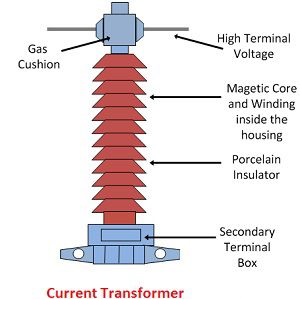
The current transformer is used with the AC instrument, meters or control apparatus where the current to be measured is of such magnitude that the meter or instrument coil cannot conveniently be made of sufficient current carrying capacity. The current transformer is shown in the figure below.


                  The primary and secondary current of the current transformers are proportional to each other. The current transformer is used  for measuring the high voltage current because of the difficulty of inadequate insulation in the meter itself. The current transformer is used in meters for measuring the current up to 100 amperes.


Construction of Current Transformers:

                   The core of the current transformer is built up with lamination of silicon steel. For getting a high degree of accuracy the Permalloy or Mumetal is used for the making cores. The primary windings of the current transformers carry the current which is to be measured, and it is connected to the main circuit. The secondary windings of the transformer carry the current proportional to the current to be measured, and it is connected to the current windings of the meters or the instruments.

                   The primary and the secondary windings are insulated from the cores and each other. The primary winding is a single turn winding (also called a bar primary) and carries the full load current. The secondary winding of the transformers has a large number of turns.


                    The ratio of the primary current and the secondary current is known as a current transformer ratio of the circuit. The current ratio of the transformer is usually high. The secondary current ratings are of the order of 5A, 1A and 0.1A. The current primary ratings vary from 10A to 3000A or more. The symbolic representation of the current transformer is shown in the figure below.


                     The working principle of the current transformer is slightly different from the power transformer. In a current transformer, the load’s impedance or burden on the secondary has slightly differed from the power transformers. Thus, the current transformer operates on secondary circuit conditions.

Burden on a Load:

                     The burden of a current transformer is the value of the load connected across the secondary transformer. It is expressed as the output in volt-amperes (VA). The rated burden is the value of the burden on the nameplate of the CT. The rated burden is the product of the voltage and current on the secondary when the  CT supplies the instrument or relay with its maximum rated value of current.

Effect of Open Secondary Windings of a CT:

                     Under normal operating conditions the secondary winding of a CT is connected to its burden, and it is always closed. When the current flows through the primary windings, it always flows through secondary windings and amperes turns of each winding are subsequently equal and opposite.

                     The secondary turns will be 1% and 2% less than the primary turns and the difference being used in the magnetising core. Thus, if the secondary winding is opened and the current flows through the primary windings, then there will be no demagnetizing flux due to the secondary current.

                      Due to the absence of the counter ampere turns of the secondary, the unopposed primary MMF will set up an abnormally high flux in the core. This flux will produce core loss with subsequent heating, and a high voltage will be induced across the secondary terminal.

                      This voltage caused the breakdown of the insulation and also the loss of accuracy in the future may occur because the excessive MMF leaves the residual magnetism in the core. Thus, the secondary of the CT may never be open when the primary is carrying the current.

Phasor Diagram of Current Transformer:

                      The phasor diagram of the current transformer is shown in the figure below. The main flux is taken as a reference. The primary and secondary induced voltages are lagging behind the main flux by 90º. The magnitude of the primary and secondary voltages depends on the number of turns on the windings. The excitation current induces by the components of magnetising and working current.


where, 
Is – secondary current
Es – secondary induced voltage
Ip -primary current
Ep – primary induced voltage
Kt – turn ratio, number of secondary turn/number of primary turn
I0 – excitation current
Im – magnetising current
Iw – working component
Φs – main flux

                     The secondary current lags behinds the secondary induced voltage by an angle θº. The secondary current relocates to the primary side by reversing the secondary current and multiply by the turn ratio. The current flows through the primary is the sum of the exciting current I0 and the product of the turn ratio and secondary current Kt Is.

Ratio and Phase Angle Errors of CT:

The current transformer has two errors
                                           1.Ratio error
                                           2.A phase angle error.

Current Ratio Errors:
                     The current transformer is mainly due to the energy component of excitation current and is given as


Where Ip is the primary current. Kt is the turn ratio and is the secondary current.

Phase Angle Error:

                    In an ideal current transformer the vector angle between the primary and reversed secondary current is zero. But in an actual current transformer, there is a phase difference between the primary and the secondary current because the primary current has also supplied the component of exciting current. Thus, the difference between the two phases is termed as a phase angle error.

What is Potential Transformer(PT) and Construction of Potential Transformer

Def. of Potential Transformer(PT):

Definition:

The potential transformer may be defined as an instrument transformer used for the transformation of voltage from a higher value to the lower value. This transformer step down the voltage to a safe limit value which can be easily measured by the ordinary low voltage instrument like a voltmeter, wattmeter and watt-hour meters, etc.

Construction of Potential Transformer:

                        The potential transformer is made with high-quality core operating at low flux density so that the magnetising current is small. The terminal of the transformer should be designed so that the variation of the voltage ratio with load is minimum and the phase shift between the input and output voltage is also minimum.

                        The primary winding has a large number of turns, and the secondary winding has a much small number of turns. For reducing the leakage reactance, the co-axial winding is used in the potential transformer. The insulation cost is also reduced by dividing the primary winding into the sections which reduced the insulation between the layers.

Connection of Potential Transformer:

                        The potential transformer is connected in parallel with the circuit. The primary windings of the potential transformer are directly connected to the power circuit whose voltage is to be measured. The secondary terminals of the potential transformer are connected to the measuring instrument like the voltmeter, wattmeter, etc.The secondary windings of the potential transformer are magnetically coupled through the magnetic circuit of the primary windings.


                         The primary terminal of the transformer is rated for 400V to several thousand volts, and the secondary terminal is always rated for 400V. The ratio of the primary voltage to the secondary voltage is termed as transformation ratio or turn ratio.

Types of Potential Transformer:


                         The potential transformer is mainly classified into two types, i.e., 
1.The conventional wound types (electromagnetic types)
2.The capacitor voltage potential transformers.

                         Conventional wound type transformer is very expensive because of the requirement of the insulations.Capacitor potential transformer is a combination of capacitor potential divider and a magnetic potential transformer of relatively small ratio.

                         The circuit diagram of the capacitor potential transformer is shown in the figure below. The stack of high voltage capacitor from the potential divider, the capacitors of two sections become C1 and C2, and the Z is the burden.


                          The voltage applied to the primary of the intermediate transformer is usually of the order 10kV. Both the potential divider and the intermediate transformer have the ratio and insulation requirement which are suitable for economical construction.

                           The intermediate transformer must be of very small ratio error, and phase angle gives the satisfactory performance of the complete unit. The secondary terminal voltage is given by the formula shown below.


Ratio and Phase Angle Errors of Potential Transformer:

                            In an ideal potential transformer, the primary and the secondary voltage is exactly proportional to the primary voltage and exactly in phase opposition. But this cannot be achieved practically due to the primary and secondary voltage drops. Thus, both the primary and secondary voltage is introduced in the system.

Voltage Ratio Error: 
                            The voltage ratio error is expressed in regarding measured voltage, and it is given by the formula as shown below.


                           Where Kn is the nominal ratio, i.e., the ratio of the rated primary voltage and the rated secondary voltage.

Phase Angle Error: 
                           The phase angle error is the error between the secondary terminal voltage which is exactly in phase opposition with the primary terminal voltage.

                           The increases in the number of instruments in the relay connected to the secondary of the potential transformer will increase the errors in the potential transformers.

Burden of a Potential Transformer:
                           The burden is the total external volt-amp load on the secondary at rated secondary voltage. The rated burden of a PT is a VA burden which must not be exceeded if the transformer is to operate with its rated accuracy.The rated burden is indicated on the nameplate.

                           The limiting or maximum burden is the greatest VA load at which the potential transformer will operate continuously without overheating its windings beyond the permissible limits. This burden is several times greater than the rated burden.

Phasor Diagram of a Potential Transformer:

The phasor diagram of the potential transformer is shown in the figure below.


Where,
Is – secondary current
Es – secondary induced emf
Vs – secondary terminal voltage
Rs – secondary winding resistance
Xs – secondary winding reactance
Ip – Primary current
Ep – primarily induced emf
Vp – primary terminal voltage
Rp – primary winding resistance
Xp – primary winding reactance
Kt – turn ratio
Io – excitation current
Im – magnetising component of Io
Iw – core loss component of Io
Φm – main flux
Β- phase angle error

                       The main flux is taken as a reference. In instrument transformer, the primary current is the vector sum of the excitation current Io and the current equal to the reversal secondary current Is multiplied by the ratio of 1/kt. The Vp is the voltage applied to the primary terminal of the potential transformer.

                       The voltage drops due to resistance and reactance of primary winding due to primary current is given by IpXp and IpRp. When the voltage drop subtracts from the primary voltage of the potential transformer, the primarily induced emf will appear across the terminals.

                       This primary emf of the transformer will transform into secondary winding by mutual induction and converted into secondary induced emf Es. This emf will drop by the secondary winding resistance and reactance, and the resultant voltage will appear across the secondary terminal voltage, and it is denoted by Vs.

Applications of Potential Transformer:

  • It is used for a metering purpose.
  • For the protection of the feeders.
  • For protecting the impedance of the generators.
  • For synchronising the generators and feeders.

                 The potential transformers are used in the protecting relaying scheme because the potential coils of the protective device are not directly connected to the system in case of the high voltage. Therefore, it is necessary to step down the voltage and also to insulate the protective equipment from the primary circuit.